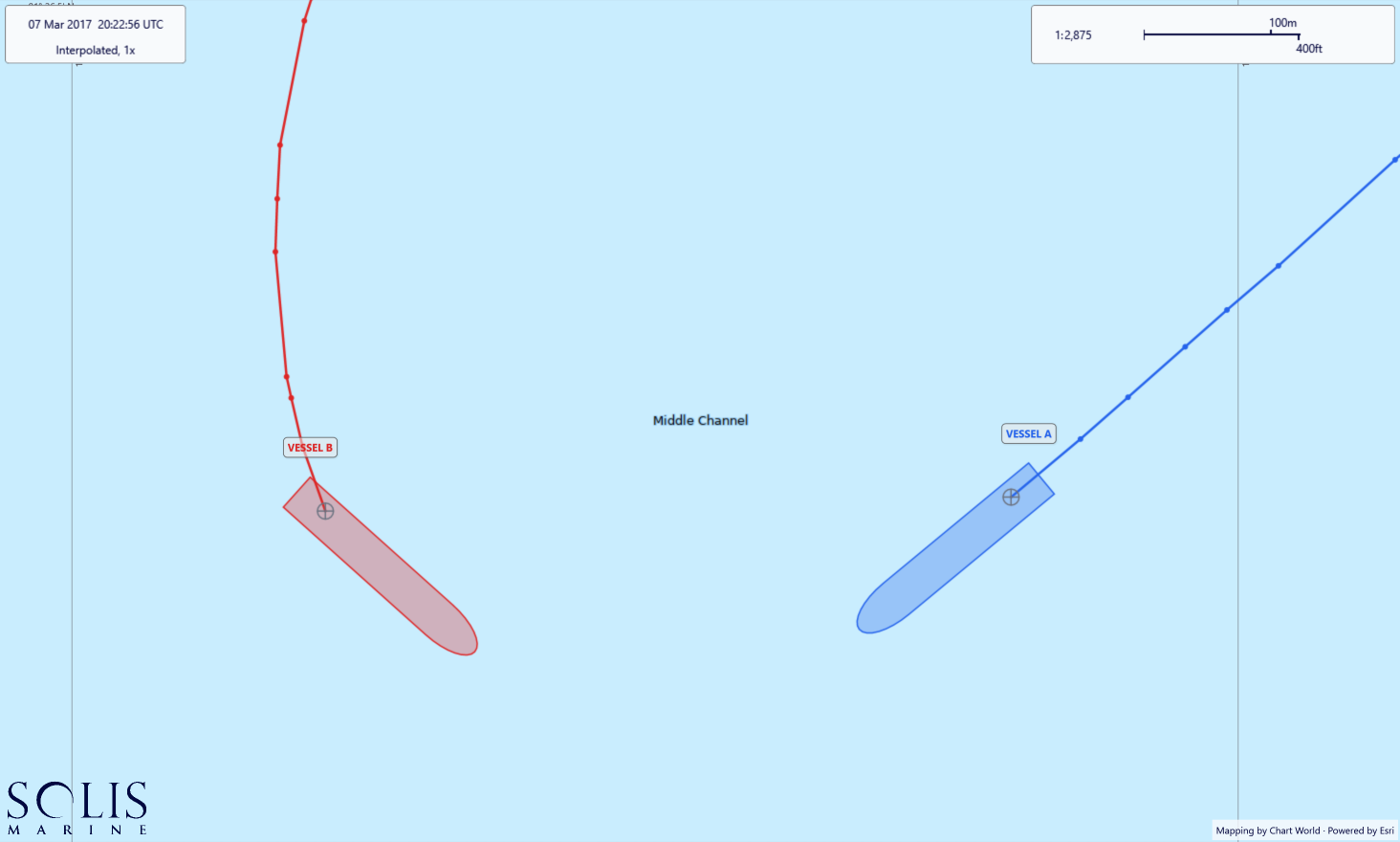
MARS is Solis Marine’s service for analysing and reconstructing shipping incidents from electronic navigation data. It builds on more than 400 cases, and our animations, plots and other outputs have been used in Courts around the world, including the Admiralty Court in London and those of Ireland, Singapore and Indonesia, among others. MARS replaces our Rapid Replay service, which we introduced in 2013.
MARS lets you work through an incident yourself, interactively and at your own pace, instead of watching a fixed video. It can show whatever electronic navigation data is available, so the reconstruction and the recorded evidence can be examined together. Collisions are the most common use, but MARS is just as well suited to groundings, allisions, disputes over berth and port usage, and other matters where a ship’s movements are in question.

MARS is not a website you log on to. You download the software, free of charge, and for each casualty we send you a link to the incident file, which opens in MARS on your own computer. The file sits on your own systems, and you decide who sees it.
Every reconstruction starts with the data. Some VDR logs are incomplete or corrupted, but in most cases we can identify and extract the critical files and convert them to usable formats, including recorded audio, images and serial data logs. The process is auditable and transparent at every stage, and we report what could and could not be extracted.
A reconstruction shows what the vessels did. Understanding why, and what a competent watchkeeper should have done, takes seagoing experience. When a matter needs independent expert opinion, our master mariners are ready to help.

Our naval architects are able to conduct manoeuvring simulations using a range of software solutions including ship dynamics simulators and computational fluid dynamics (CFD).
Simulations can be used to investigate 'what if' scenarios as well as to consider more complex issues such as shallow water effects.

Our incident investigation services extend to vessel traffic analysis when wider issues such as sanctions, loss of use of a berth and common navigational practices are important.
We provide a range of traffic analysis options which can be presented visually in the form of heat maps and plots on navigation charts, or simply through a spreadsheet providing statistical analysis of data.