
.png)
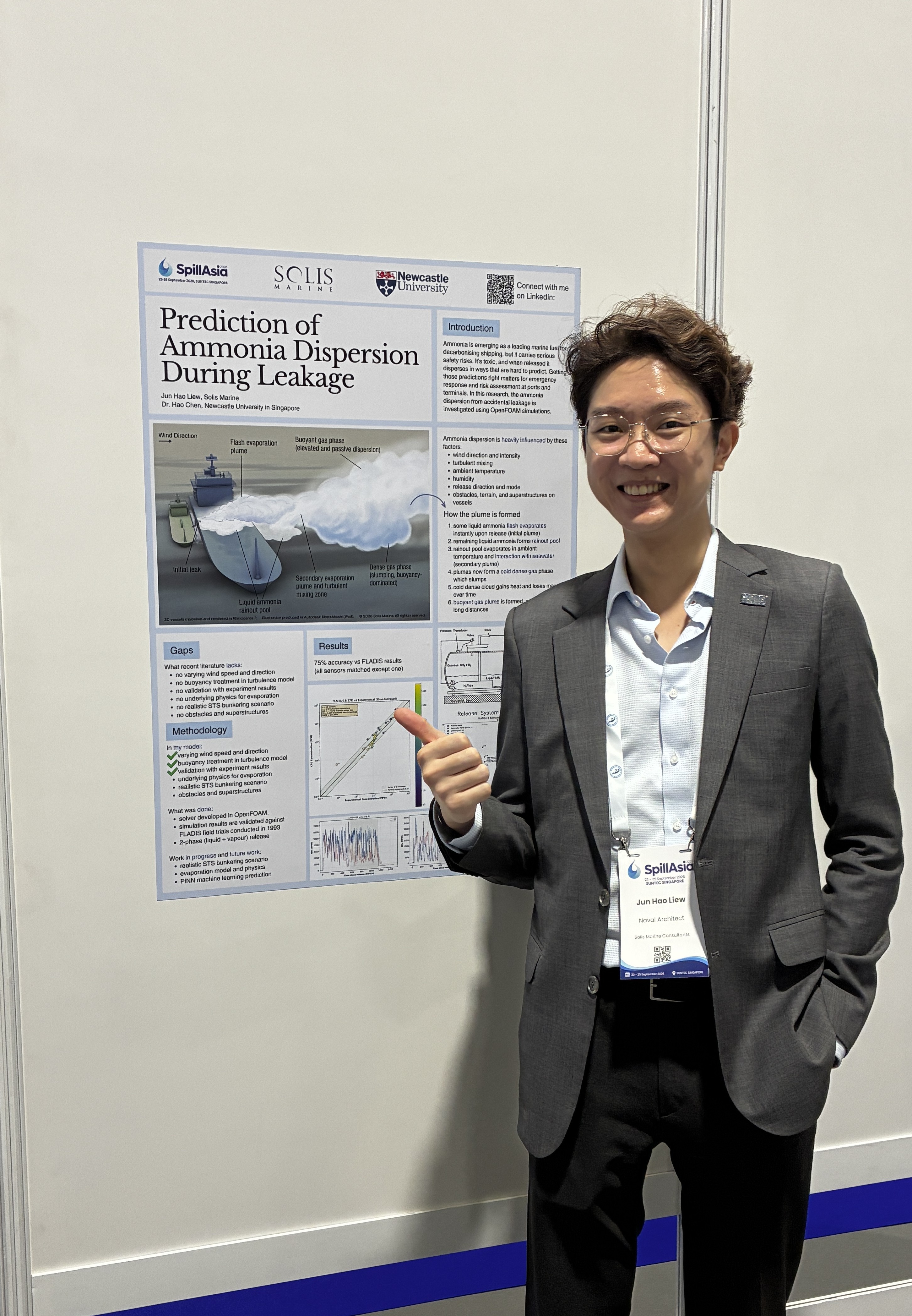
At SpillAsia 2026 in Singapore, Jun Hao Liew of Solis Marine presented the poster “Prediction of Ammonia Dispersion During Leakage,” co-authored with Dr Hao Chen of Newcastle University in Singapore. The poster summarises the second year of his doctoral research, which Solis Marine supports through the Industrial Postgraduate Programme with Newcastle University in Singapore. The research asks a practical question: if liquid ammonia leaks during a ship-to-ship bunkering operation, where does the gas go, how concentrated is it, and who is exposed?
Shipping produces roughly 2.5% of global carbon dioxide emissions, and the IMO has set progressively stricter decarbonisation targets for the sector. Ammonia is one of the more practical carbon-free fuels, with an estimated reduction in greenhouse gas emissions of around 85% compared with conventional marine fuels. Its main drawback is toxicity. Ammonia is harmful at low concentrations, and a leak during bunkering could expose the crews of both vessels and people nearby.
Safety zones and emergency plans depend on knowing how a release will spread. Current knowledge has three limitations. The main ammonia field trials were carried out on open, flat ground, so they do not show how ship hulls and superstructures affect the gas. The simplified dispersion models used in much of today’s maritime risk guidance assume a smooth plume and cannot represent the sheltered pockets and recirculating air around a vessel, which is where the crew work. And releasing a toxic gas at full scale to test these effects is costly and dangerous. Computer simulation can fill this gap, but only if the model is first proven against real measurements.
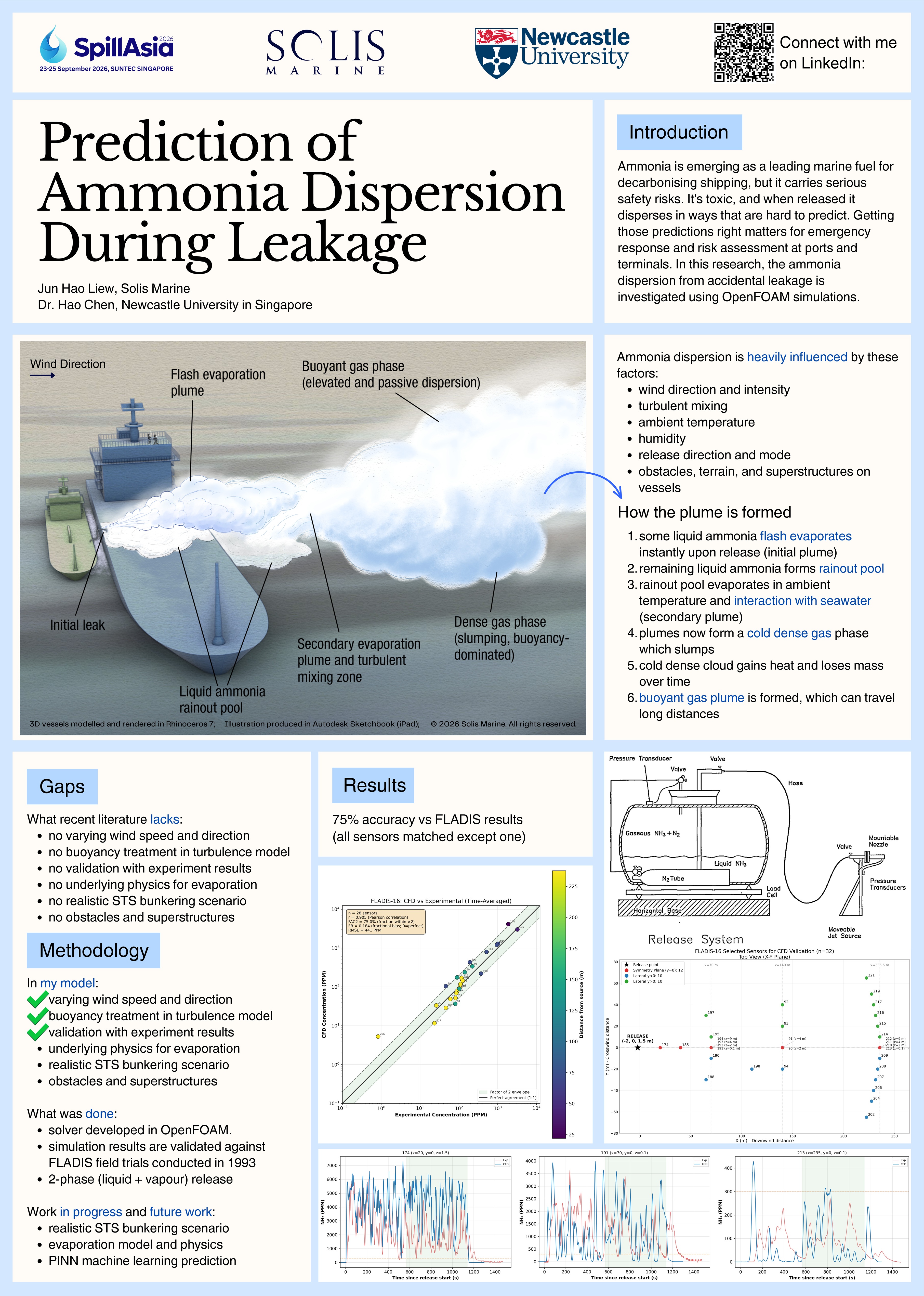
Ammonia is stored on board as a liquid under pressure. When it escapes, part of the liquid boils into vapour immediately. The remainder leaves the leak as fine droplets. In a release over water, some droplets can fall to the sea surface and form a pool, which evaporates and reacts with the seawater.
As the droplets evaporate, they draw heat from the surrounding air. Calculations for the trial put the cloud temperature at around −70 °C, well below the boiling point of ammonia. At that temperature the cloud is heavier than air, so it sinks and spreads out close to the surface instead of rising. As it mixes with warmer air and takes up heat from the ground, it loses this excess weight and is carried by the wind as an ordinary plume. In the field trial, the plume stayed close to the ground across the full 238 metres of the sensor array. Further downwind, once the gas has warmed, it can rise, because ammonia is lighter than air at the same temperature. This is why standard reference descriptions of ammonia as a light gas can mislead responders about the first minutes of a release.
Jun Hao developed the model in OpenFOAM, an open-source simulation software package. He modified the solver so that it accounts for the weight of a cold, dense cloud and for how the gas diffuses into the surrounding air. He documented the modifications through the advanced OpenFOAM course at Chalmers University of Technology.
The model was tested in two stages. First, it was compared with wind tunnel measurements from the University of Hamburg, where a heavy gas was released onto a sloped surface. Second, it was compared with trial 16 of the FLADIS field experiments, conducted in August 1993 at the Hydro-Care training site in Landskrona, Sweden, under the coordination of Risø National Laboratory in Denmark. Pressurised liquid ammonia was released at 0.27 kg/s for 20 minutes, and concentrations were measured along arcs of sensors 20, 70 and 238 metres downwind. The recorded wind speed and direction were fed into the model, so the simulated plume shifted with the wind as the real one did. In the trial, the plume swept from side to side about twice a minute.
At the 28 sensor positions used for the comparison, the model predicted 75% of the concentrations to within a factor of two of the measured values. The accepted threshold for a dispersion model is 50%, and the result is comparable to established dispersion codes assessed against the same trial in a recent international comparison.
With the model validated, Jun Hao applied it to a ship-to-ship bunkering arrangement. A bunker tanker lies alongside a larger receiving vessel, with the wind blowing across both hulls, and the model area extends up to 2.5 km downwind. These simulations are run on ARCHER2, the UK national supercomputing service. They show how the gas behaves in the sheltered spaces between and around the two vessels, which open-terrain trials cannot capture.
In the third year of the programme, Jun Hao will compare turbulence models to select the most reliable one for the ship case. He will then run a series of simulations that vary the wind speed and direction, the relative positions of the two vessels, and the arrangement of deck structures. The results will feed a risk framework that defines safety and hazardous zones on board during bunkering. The framework will also identify practical measures that reduce the extent of those zones, such as vessel positioning, deck layout, and wind limits for transfer operations.
Jun Hao plans to publish two journal papers by 2027. The first, for an ocean or marine engineering journal, will set out the dispersion footprints across bunkering conditions, the resulting safety and hazardous zones, and the measures that reduce them. The second, for a physics or fluid mechanics journal, will examine how buoyancy and turbulence interact in the dense cloud close to the leak, and what that means for the concentrations crew may be exposed to.
Jun Hao is supervised by Rosalind Blazejczyk, Simon Hindley and Richard Pemberton at Solis Marine, and by Dr Hao Chen and Professor Cheng Siong Chin at Newcastle University in Singapore.
Rosalind Blazejczyk discussed ammonia release behaviour and its implications for salvors at the IMO R&D Forum earlier the same week.
Solis Marine is an independent marine consultancy providing casualty management, naval architecture, engineering and expert witness services worldwide. For more information, contact the team at www.solis-marine.com.